

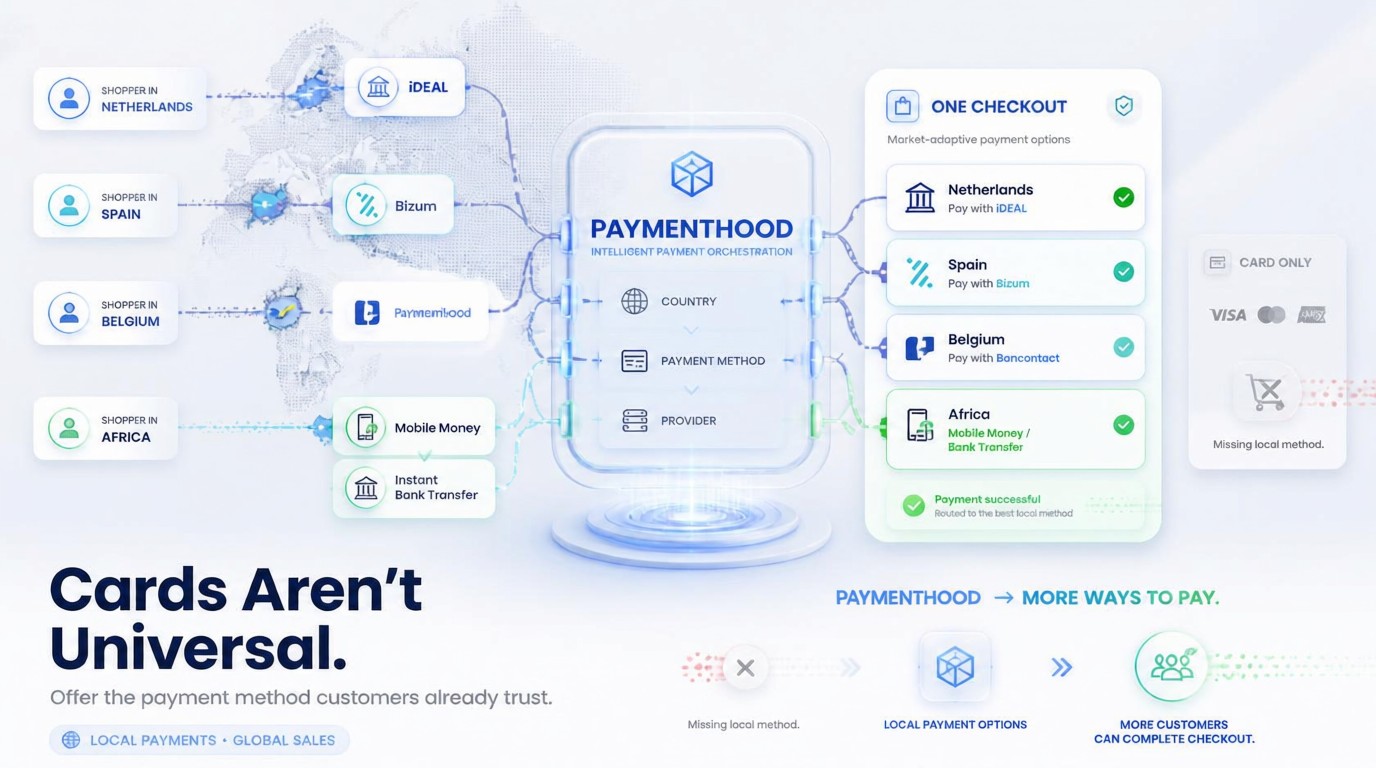
You open a new market. Traffic arrives, the product is right, the prices are fair, and conversion is quietly disappointing. It’s tempting to blame the market, the pricing, or the ad targeting. Often the real culprit is the last screen the customer sees: the checkout offered a card, and the customer was waiting to pay a different way.
Cards feel universal if you grew up with them. In much of the world they aren’t. A shopper in the Netherlands reaches for iDEAL. A shopper in Spain reaches for Bizum. In Belgium it’s Bancontact; across large parts of Africa it’s mobile money and instant bank transfers, not an international card at all. When the method they trust isn’t on the checkout, a meaningful share of ready-to-buy customers simply leave, and like a currency mismatch, they don’t email you about it. They just don’t convert.
Why local methods decide the sale
Two forces are at work, and neither is about price:
- Trust. People pay through the rails they already use for everything else. A method they recognise, one that confirms inside their own banking app, clears a hesitation that an unfamiliar card form doesn’t.
- Coverage. In many markets, card penetration is genuinely low, or cross-border card acceptance is unreliable. For those shoppers a local method isn’t a preference, it’s the only way they can pay you.
The effect is invisible in your dashboards. You see sessions and add-to-carts, then a drop at payment, and you reach for explanations that have nothing to do with the one screen that actually lost the sale.
The catch: every local method is its own integration
Once you accept that you need local methods, the operational problem appears. These rails don’t come from one place:
- Bizum and iDEAL are reached through European providers; Paystack, Flutterwave or mobile-money aggregators cover African markets; each region has its own.
- Every one is a separate integration: its own API, its own webhook format, its own reconciliation and its own quirks.
- Presenting the right method to the right shopper (iDEAL to the Dutch customer, Bizum to the Spanish one) means logic somewhere that decides, per checkout, what to show.
Do that market by market and “add local payment methods” becomes ten projects, not one, which is exactly why so many stores never get past cards, and keep losing the sales they can’t see.
How to do it without ten integrations
The workable approach is to treat local methods as a routing problem, not an integration-per-provider problem: one integration in front of many providers, which presents the methods that fit each shopper’s market and settles them behind the scenes. Add Bizum for Spain or iDEAL for the Netherlands the same way you’d toggle any other option, not by rebuilding checkout each time. This is what a payment orchestration platform is for, and it’s the same reason it solves the related currency-mismatch problem: the decision about how a customer pays lives in configuration you control.
For the operational side of this (which method to enable in which market, and the difference between the currency you charge and the one you settle in), see accepting global payments.
How PaymentHood offers local methods
PaymentHood connects your store to 30+ providers: cards, wallets, and regional rails like Bizum, iDEAL and Bancontact alongside African methods, through one integration. You enable the methods each market needs and route by country, so a Spanish shopper is offered Bizum and a Dutch shopper iDEAL, without a plugin or a rebuild per provider. Webhook verification and server-side confirmation are handled once, centrally, and there’s no per-transaction fee from PaymentHood. You pay only your chosen provider’s processing fees.
Because it’s one integration, adding the local method for a market you’re losing sales in is a dashboard change rather than a new build, and you’re never limited to whichever methods a single provider happens to support.
Where PaymentHood fits
If a new market is underperforming and you can’t quite say why, check the payment methods your checkout offers there before you blame anything else; the sale is often lost to a missing local rail, not to the market. PaymentHood lets you offer the right local methods per market through one free integration, with routing, failover, webhook verification and server-side confirmation built in. Free plugins are available for WooCommerce, WHMCS, VirtueMart, Phoca Cart and J2Commerce.
Create a free PaymentHood account, or browse the provider directory to see which local methods are covered in your markets.