

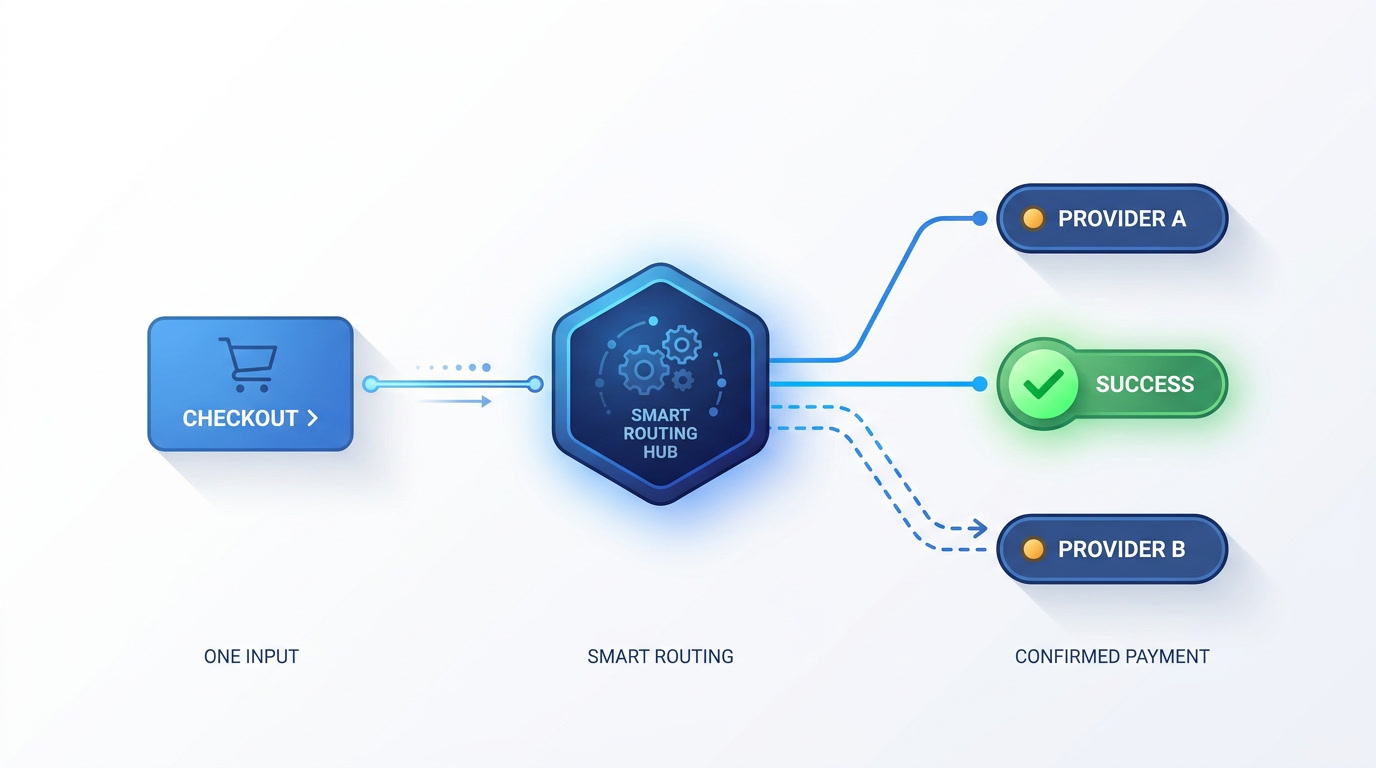
Most explanations of payment orchestration stop at the definition: a layer between your checkout and your payment providers. True, but it doesn’t tell you what actually happens to a payment as it passes through. This is the practical version: how payment orchestration works, step by step, with concrete rules and a real example, so you can see exactly where it earns its place.
If you want the plain-English concept first, start with what payment orchestration is. This guide assumes you have that and asks the next question: what does the layer do with each payment?
Payment orchestration in one sentence
A payment orchestration platform takes one payment request from your checkout, decides which provider should handle it, sends it there, retries elsewhere if that fails for a technical reason, confirms the result, and records it in one ledger, all without your checkout code knowing which provider was used. Your store integrates once; the routing, failover and reconciliation live in configuration.
Everything below is one of those steps, unpacked.
Step 1. Routing: every payment gets a decision
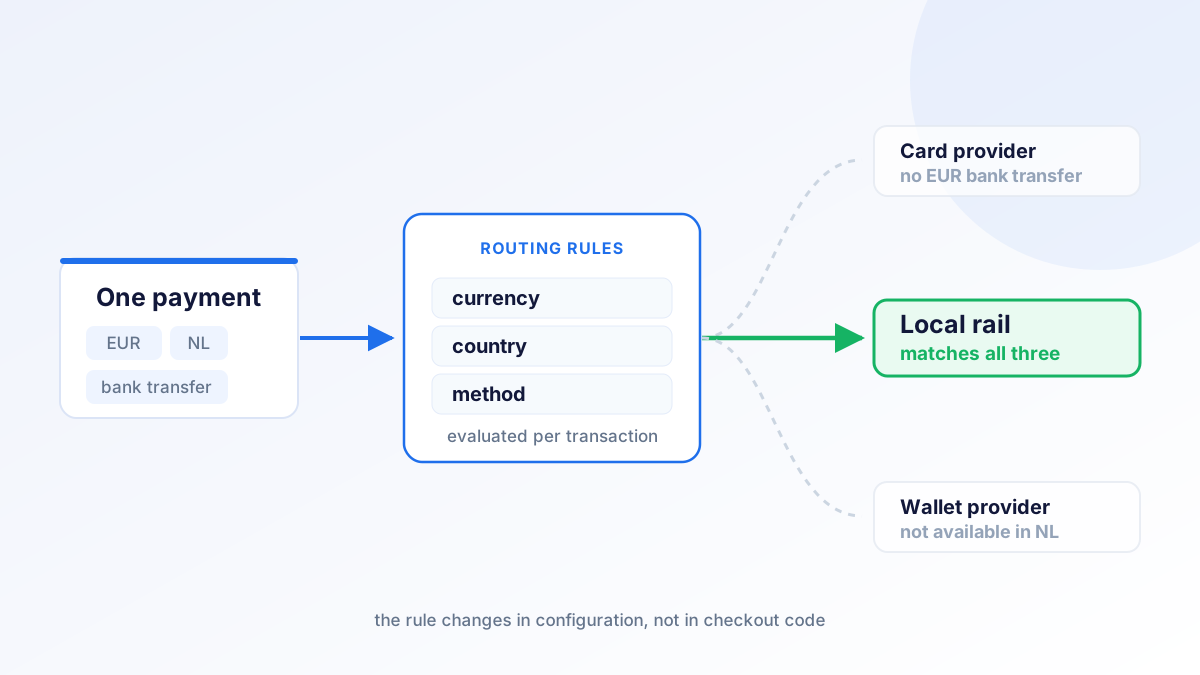
With a single provider there is no decision to make. Every payment goes to the same place, which is exactly the limitation. Orchestration turns “which provider” from hard-coded logic into a rule you can change. The inputs are usually currency, country, payment method, amount, and each provider’s live health.
A routing rule set might read like this:
| Order condition | Route to | Why |
|---|---|---|
| Priced in EUR, shopper in Spain | Provider A (offers Bizum) | Local method the shopper trusts |
| Priced in NGN, shopper in Nigeria | Provider B | Settles the currency, local acquiring |
| A card payment, everything else | Provider C (best card rate) | Default, lowest cost |
| Provider C unhealthy right now | Provider D | Live failover, see Step 2 |
The point is not the specific rules. It’s that adding a market or a method becomes activating a provider and writing a rule, not shipping new checkout code. It is also the structural fix for the checkout error that quietly kills international sales, payment method not available for your currency: the layer simply routes that shopper to a provider that can take their money.
Step 2. Failover and retries: an outage is not a lost sale
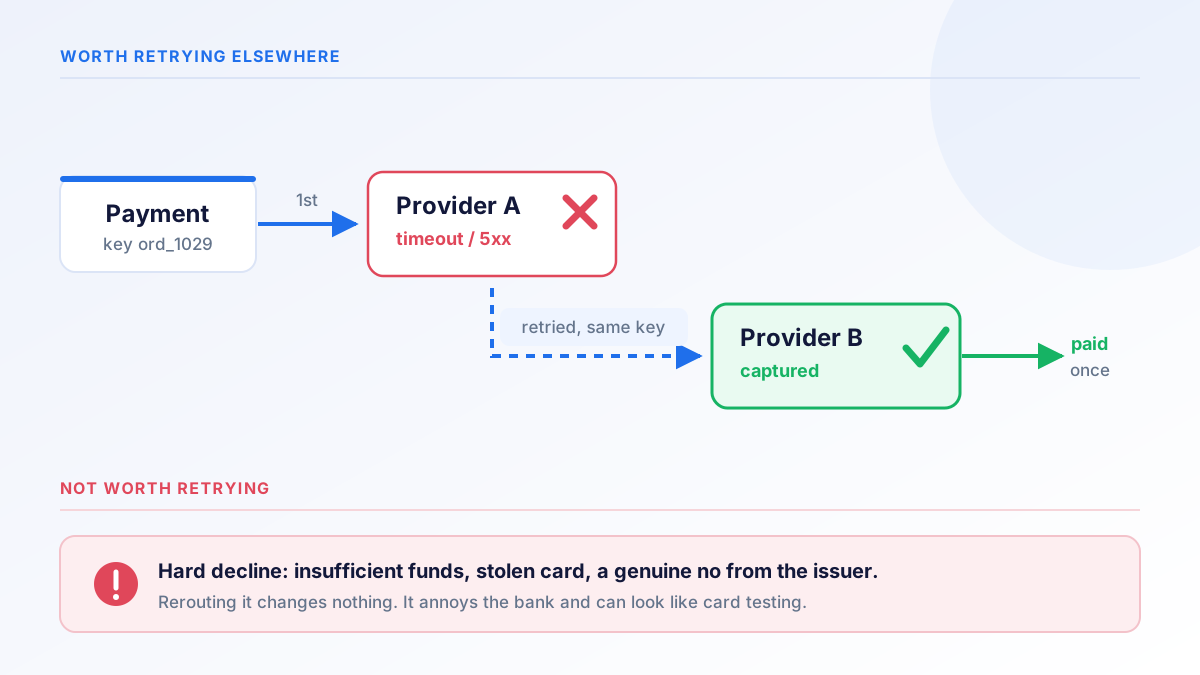
Every provider has a bad day. Without a fallback, their downtime is your downtime: every payment fails until they recover, and you usually hear it from customers. With orchestration, a technical failure (a timeout, a 500, a gateway outage) is retried through another healthy provider while the shopper is still on the page.
The discipline is in what not to retry:
- Retry technical failures: timeouts, connection errors, provider-side 5xx.
- Never retry a hard decline like insufficient funds or stolen card. That is the issuer’s answer, not a fault; re-running it elsewhere can’t succeed and can look like card testing.
The full architecture of this step (the three layers it needs and the one most teams miss) is in how payment failover is actually built.
Getting that distinction right is also most of what lifts your payment approval rate, and it is the same machinery behind surviving a gateway outage.
Step 3. Idempotency: how the double charge is prevented
This is the least glamorous step and the one that costs the most when it’s missing. Networks time out. Users double-click “Pay”. Retry logic fires twice. Any of these can turn one intended payment into two real charges on a real card, a duplicate that looks like fraud to the customer but was self-inflicted.
Here is exactly how it happens, and how the layer stops it:
- Your checkout sends a charge. The provider processes it, but the response times out on the way back, so as far as your system knows, it failed.
- Failover (Step 2) retries the “failed” payment through another provider. Now the card has been charged twice.
An orchestration layer prevents this with an idempotency key: a unique token attached to the payment attempt, not the provider call. A repeated request with the same key returns the original result instead of creating a second charge, and failover carries that key so the retry can’t double-charge. Without one payment identity across providers, the numbers never reconcile and duplicates slip through, which is why idempotency belongs in the layer, once, not in each provider integration.
Step 4. Verification and reconciliation: paid means the provider said so
Two habits separate a robust payment flow from a lucky one:
- Server-side confirmation. An order is marked paid only when your server queries the provider and the provider confirms the capture, never because the browser was redirected to a success page. That redirect is attacker-controllable.
- Webhook signature verification. Every provider signs callbacks differently. The layer verifies each scheme once, centrally, so a forged “payment succeeded” callback can’t take goods without paying.
Then reconciliation: five providers means five settlement reports in five formats. Orchestration normalises them into one ledger, so “what did we take yesterday” is a query, not a spreadsheet merge.
A worked example, end to end
A shopper in Spain checks out for €80.
- Route. The layer sees EUR + Spain and offers Bizum through the provider that supports it (Step 1).
- Attempt. The charge goes out with an idempotency key. The provider captures it, but the confirmation times out (Step 3).
- Failover? Retry logic would normally re-send to another provider. Because the idempotency key travels with it, the layer recognises the payment already succeeded and returns the original result instead of charging again: no duplicate (Step 3).
- Confirm. The server verifies the capture directly with the provider and the signed webhook checks out (Step 4). Only now is the order marked paid.
- Record. The €80 lands in one ledger next to every other provider’s transactions (Step 4).
Same flow with a single direct integration: the timeout looks like a failure, a naive retry double-charges, and finance finds the mismatch days later. That gap is the whole argument for a layer.
How PaymentHood does payment orchestration
PaymentHood is a payment orchestration platform that runs every step above across 30+ providers through one integration: routing, failover, idempotent charges, webhook verification, server-side confirmation and one reconciliation ledger, all handled for you. The routing rules live in a dashboard, so adding a provider or a market is configuration, not a redeploy, and there’s no per-transaction fee from PaymentHood. You pay only your chosen provider’s processing fees.
For stores on WooCommerce, WHMCS, VirtueMart, Phoca Cart or J2Commerce, the integration is a free plugin install rather than a development project.
Frequently asked questions
How does payment orchestration decide which provider to use? It applies routing rules to each payment, usually based on currency, country, payment method, amount and each provider’s current health, then sends the payment to the provider that best matches. The rules live in configuration, so you change them without touching checkout code.
Does payment orchestration cause double charges? The opposite: done properly it prevents them. An idempotency key ties each payment attempt to one identity across providers, so a timeout or a failover retry returns the original result instead of charging the card a second time.
Can I see one report across all my providers? Yes. Orchestration normalises every provider’s transactions into a single reconciliation ledger, so you reconcile once instead of merging separate settlement reports by hand.
Do I have to code the routing rules myself? With PaymentHood, no: routing, failover and retries are configured in a dashboard, and your checkout keeps talking to one API regardless of which providers sit behind it.
Where PaymentHood fits
Payment orchestration is only worth understanding step by step because each step (routing, failover, idempotency, verification, reconciliation) is a place a single-provider setup silently loses money. PaymentHood runs all of them for you across 30+ providers through one free integration, so you get the behaviour without building it.
Create a free PaymentHood account, or browse the provider directory to see which providers you could route across.