


Most writing about AI agents and money is about authority: how much an agent may spend, on whose behalf, and who is liable. Those are real questions and they are being worked on in public.
This is about something narrower and more immediate. Long before an agent is trusted with a budget, it is already making the same HTTP call your checkout makes, and it behaves differently from a human in one specific way that payment systems were not designed for.
A person who is not sure whether their payment went through stops and checks. An agent tries again.
Everything below follows from that sentence.
The gap a human quietly covers
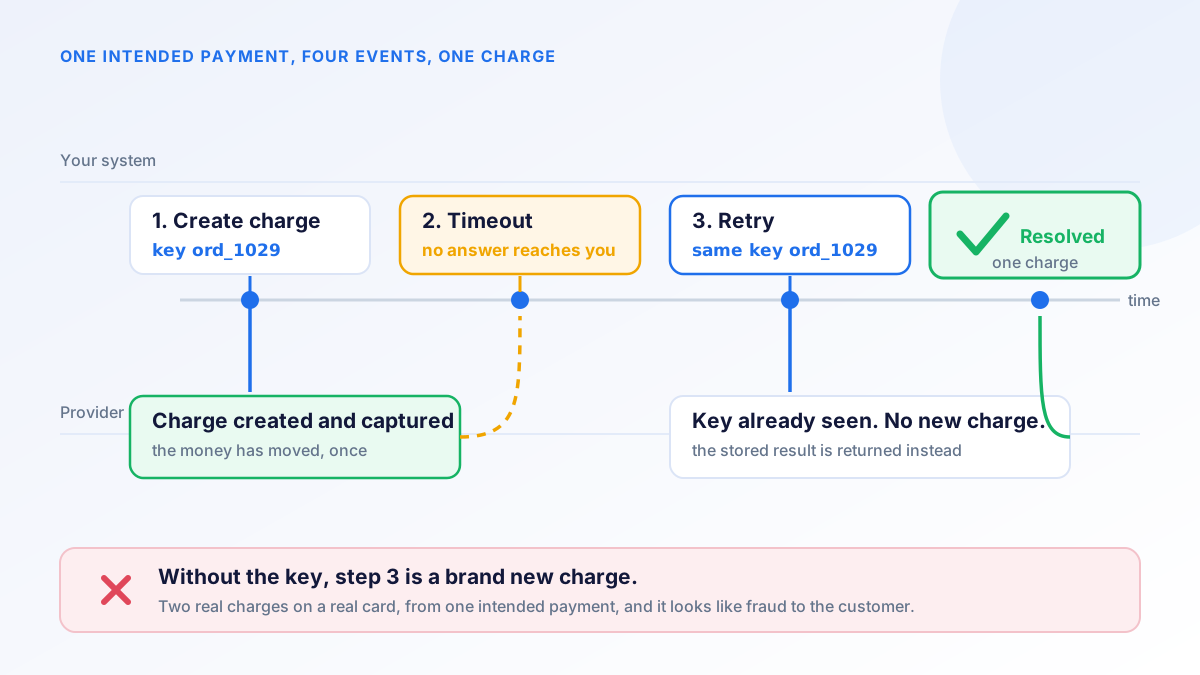
Consider the ordinary failure: your system sends a charge, the provider processes it, and the response is lost on the way back. A timeout. Your system knows only that it did not hear an answer.
This is not rare. It is the normal failure mode of a network, and it happens to every payment system at some volume.
With a person at the keyboard, an informal safety net engages. They see a spinner that never resolves. They do not immediately press pay again, and when they do, they usually check their bank first, or email support, or wait. If they are charged twice they notice and complain, which is unpleasant but is also a repair mechanism. Human hesitation has been silently compensating for imperfect payment code for decades.
An agent has none of that. It receives a timeout, classifies it as a retryable error, and retries: in milliseconds, with an identical request, with no notion that money may already have moved. If your idempotency is weak, the customer is charged twice before anyone could have looked.
Four ways it goes wrong
Retry velocity. A human retries three times over ten minutes. An agent with an exponential-backoff policy can produce a dozen attempts in a minute, and a dozen attempts against a card is also, from your provider’s point of view, a pattern that looks like card testing. You can trip your own fraud controls with entirely legitimate traffic.
Unknown state treated as failure. Systems tend to encode “no response” as failure because that is the safe assumption for a read. For a write that moves money it is the dangerous one. The correct response to a timeout is a status query, not a retry: go and ask the provider what actually happened. Agents overwhelmingly do the second.
No shared memory of the attempt. Two agent runs, or the same agent after a restart, have no idea a charge is in flight. Whatever remembers that has to live in your payment layer, not in the agent’s context, because the context is the least durable thing in the system.
Confident narration. An agent will report success or failure in fluent prose based on what it inferred, and a timeout narrated as “the payment failed” is a statement your user will act on. The truth is that nobody knows yet, which is a harder sentence to say and the only accurate one.
The requirement this produces
None of this is exotic. It is the ordinary correctness of a payment system, held to a standard where human hesitation is no longer papering over the gaps:
- The identity of a payment attempt cannot be per-request. A key generated when the HTTP call is made protects nothing, because the retry is a new call and gets a new key. It has to be derived from the order and reproducible without the agent remembering anything.
- That identity has to live above the providers. Provider A’s idempotency key means nothing to provider B, so the moment a retry crosses providers is the moment provider-level protection stops working, the argument in how payment failover is actually built.
- Unknown has to be a real state. Not a synonym for failed. Something has to resolve it by asking the provider, with a bounded time before a human is involved.
- Terminal states have to be terminal. An agent that can retry a payment marked final will eventually try.
- Rate limits have to exist on your side. Not because the agent is hostile, but because it does not get tired.
Deriving a key that actually protects you
An idempotency key is the whole defence, and it is usually the part implemented wrongly, not because the concept is hard, but because the wrong derivation looks correct in every test that gets written.
The rule is that the key must identify the payment attempt, not the request. A key generated fresh per HTTP call provides no protection at all: the retry carries a different key, the provider sees an unrelated payment, and you get two charges. This is the single most common implementation error, and it passes every happy-path test, because the happy path never retries.
Derive it from something stable that both the caller and the retry already know: the order identifier plus an attempt number is usually enough. If you cannot name what makes it stable, it is not stable.
The subtlety that catches people out is which retries share a key:
- A retry after a timeout is the same attempt. It must reuse the original key, so the provider can tell you what happened to the first request instead of performing a new charge.
- A retry after a definitive decline is a new attempt. It needs a new key; reuse the old one and you will get the cached decline back forever and conclude, wrongly, that the card is dead.
Automation makes both cases sharper. A human who sees a timeout waits, reloads, and often gives up; a script retries in milliseconds, sometimes in parallel, and keeps going. A key that is merely usually-correct will be found out.
What the provider gives you, and what it does not
Most major providers support idempotency keys, and it is tempting to treat that as the problem being solved. It solves one layer of it.
The provider guarantees that two requests carrying the same key produce one charge, generally within a retention window measured in hours or days. That is real and valuable. Three things it does not do:
It does not span providers. A key is scoped to the provider that received it. If a retry is routed elsewhere, which is exactly what failover does, the second provider has never seen that key and will happily create a second payment. Retry identity has to live above the providers, in your own layer, or failover and idempotency actively work against each other. That is the design problem at the heart of failover.
It does not cover your own side. If your system creates a second payment record before the call, or your job runner starts two workers on the same task, the provider never sees a duplicate key because your system genuinely made two distinct attempts. The guarantee protects the network hop, not your orchestration of it.
It expires. A retry that arrives after the retention window is a new payment as far as the provider is concerned. Automated systems with long backoff schedules can and do cross that boundary.
Proving it works before it matters
Idempotency is easy to believe you have and hard to notice you do not, because the failure only appears under conditions nobody reproduces casually. Four tests settle it, and each takes an afternoon:
- Send the same charge twice with the same key. Expect one payment and two identical responses.
- Kill the connection mid-charge, then retry. Expect the system to reach a resolved state with exactly one charge; this is the test that finds a key generated per request.
- Fire two workers at the same payment simultaneously. Expect one charge, not a race that both sides win.
- Retry after a decline with the old key. Expect a new attempt to be possible; if you get the cached decline back, your key is too coarse.
None of these require a provider sandbox that simulates failure. They require breaking the connection at your own boundary, which you control. The broader pre-launch list is a separate exercise, and the failure taxonomy that decides what deserves a retry at all is in why payments fail.
What this is not
Worth being clear about the boundary, because this space attracts overclaiming.
PaymentHood does not issue virtual cards, enforce per-agent spending limits, or implement agent-payment protocols such as AP2 or x402. Those are real areas of work and other people are doing them; we are not, and a page saying otherwise would be marketing rather than engineering.
What we do is the layer underneath all of that, and the argument of this post is that the layer underneath is where the failures actually happen. An agent framework with excellent spending controls sitting on a payment integration whose idempotency key is generated per request will still double-charge customers.
If you think it has already happened
Duplicate charges are usually discovered from the customer side, which means by the time anyone looks the transaction is days old and the logs have rotated. Three checks find them without a rebuild.
Look for charges close together with the same amount and customer. A window of a few minutes catches almost all retry duplicates, because automated retries are fast by nature. If two charges are hours apart, that is a different problem - usually a scheduler running twice.
Compare provider transaction counts against your own. If the provider shows more successful payments than your system recorded, the difference is either duplicates or payments whose confirmation never arrived. Both matter and they need different fixes.
Check whether refunds cluster. Support refunding the same customer twice in a month, repeatedly, is the human-visible shadow of a duplicate-charge bug that nobody has traced to its cause.
Once found, the fix is upstream rather than in the refunding. Duplicates are almost always one of three things: a key generated per request instead of per attempt, a retry that moved providers and lost its identity, or two workers racing on one task. Each is cheap to fix and expensive to leave, because the rate is proportional to traffic and therefore grows exactly as the business does.
Where PaymentHood fits
PaymentHood is a payment orchestration platform: one integration between your application and 30+ providers, with routing, failover, idempotency, webhook verification and reconciliation handled in the layer rather than in whatever is calling it.
The property that matters here is where the identity of a payment lives. Charge creation is idempotent on your own order reference, checked before any provider is contacted, so a repeated create returns the original payment rather than making a second one, whichever provider is involved and however fast the caller is. And payments left in flight are resolved by querying the provider for what actually happened, rather than by inferring an outcome from a dead connection.
That is not an agent feature. It is a payment-correctness feature that agents make much harder to skip.
Create a free PaymentHood account, or read payment infrastructure for SaaS for what the rest of the layer has to do.